Last updated: October 16, 2026. This article is general information, not medical advice. If you have a medical condition, a history of disordered eating or specific nutrition needs, talk to your doctor or a registered dietitian before changing how you eat.
Calorie density is the number of calories in a given weight of food, usually shown as calories per gram. Foods with a lot of water and fiber, like vegetables, fruit and soups, have few calories per gram, so you can eat a full, satisfying portion for relatively few calories. Foods high in fat and low in water, like oils, nuts, chips and pastries, pack many calories into a small amount.
You don’t need to give up calorie-dense foods. The idea is to build most of your plate from foods lower in calorie density, so meals fill you up before the calories add up. Below: how to work it out, a chart of common foods, two meals compared side by side, and the limits of the approach.
How to work out calorie density
The formula is simple: divide the calories by the weight in grams.
On a packaged food, use the Nutrition Facts label. A granola with 240 calories per 55 g serving has a calorie density of 240 ÷ 55 = about 4.4 calories per gram, which is high. A vegetable soup with 100 calories per 240 g serving comes out at about 0.4, which is very low. If you’re not sure where to find those numbers, our guide on how to read a Nutrition Facts label walks through it.
Three things set a food’s calorie density:
- Water adds weight and volume with zero calories. It’s the main reason fruit, vegetables and soups are so low.
- Fiber adds bulk with relatively few calories, about 1.5 to 2.5 per gram.
- Fat has 9 calories per gram, more than twice the 4 calories per gram in protein and carbohydrates. A little oil or butter raises the density of a dish quickly.
Two foods can have the same calories and still feel completely different on your plate. 100 calories of strawberries is a big bowl; 100 calories of almonds is a small handful. That difference is calorie density, and it’s one of the simplest ideas you can use to eat fewer calories without feeling hungry. Enter any food below to see where it lands.
Calorie Density Calculator
Find out how many calories a food packs per gram, and how much of it you can eat for the same calories. Low-density foods let you eat bigger, more filling portions for fewer calories.
The 4 calorie density categories
Compare common foods
Click any food to load it into the calculator.
| Food | kcal per 100 g | kcal/g | Category |
|---|
Categories follow the widely used Volumetrics-style ranges (very low below 0.6, low 0.6–1.5, medium 1.5–4, high 4–9 kcal per gram). Food values are approximate averages and vary by brand and preparation; check the label for exact figures. This calculator is for general information only and is not medical or nutrition advice.
What is calorie density?
Calorie density (also called energy density) is the number of calories in a given weight of food, usually shown as calories per gram. You calculate it by dividing the calories in a serving by the serving’s weight in grams. A food with 0.5 calories per gram gives you twice as much food for the same calories as one with 1.0, and eight times as much as one with 4.0.
How to use this calculator
- From calories: take the Nutrition Facts label, enter the serving size in grams (it’s shown in parentheses next to the serving size, e.g. “1 cup (228g)”) and the calories per serving.
- From macros: if you only know protein, carbs, fat and fiber, switch to the macros tab. The calculator estimates calories using standard values (4 calories per gram for protein and carbs, 9 for fat).
- Compare foods: tap “Add to comparison” to build a list sorted from lowest to highest density. Your list stays saved in your browser.
Why it matters for weight loss
Research on energy density, led largely by Dr. Barbara Rolls at Penn State, suggests that people tend to eat a fairly consistent weight of food from day to day. Choosing foods that are lower in calorie density lets you eat a satisfying amount while taking in fewer calories. Foods with a lot of water and fiber, like vegetables, fruit, soups and beans, are naturally low in calorie density. Foods high in fat and low in water, like nuts, oils, chips and pastries, are the highest.
Practical tips
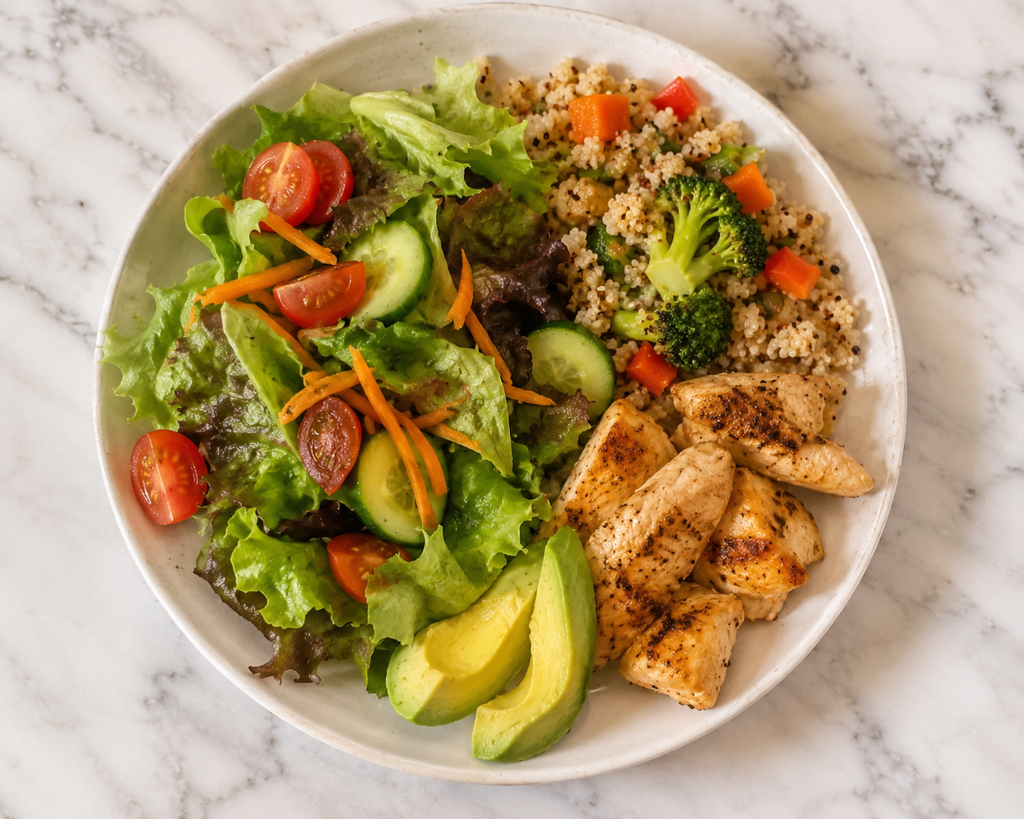
- Fill half your plate with very-low-density foods such as salad greens, cooked vegetables or broth-based soup.
- Don’t cut out high-density foods entirely. Nuts, olive oil and avocado are nutritious; just use smaller portions.
- Add volume to calorie-dense dishes. Mix vegetables into pasta, rice or omelets to lower the density of the whole meal.
- Watch for hidden fat. Frying, creamy sauces and dressings can move a low-density food into the high range.
Frequently asked questions
Is low calorie density always healthier?
Not necessarily. Calorie density measures how filling a food is for its calories, not its overall nutritional value. A balanced diet includes foods from every range.
What’s a good calorie density target?
Many people following this approach aim to make most of their meals from foods under about 1.5 calories per gram, while still including small amounts of denser foods.
Why does my result differ from another website?
Calorie values vary by brand, variety and cooking method. For packaged foods, the product’s own Nutrition Facts label is the most accurate source.
This calculator is for informational purposes only and is not medical or nutritional advice. Talk to a doctor or registered dietitian before making major changes to your diet.
Why it helps you feel full
People tend to eat a fairly consistent amount of food by weight and volume from meal to meal. When that food is lower in calorie density, the same full plate simply contains fewer calories, without leaving you hungrier.
Several studies support this. In a year-long trial published in the American Journal of Clinical Nutrition in 2007, 97 women with obesity followed one of two diets without calorie targets. Both groups cut back on fat, but one group was also told to eat more water-rich foods, mainly fruit and vegetables. That group ate a greater weight of food, reported less hunger and lost more weight on average (7.9 kg vs 6.4 kg).
Shorter studies point the same way. In one, women who started a pasta lunch with a large, low-calorie salad ate about 11% fewer calories at the meal overall. A CDC research summary also describes a one-year trial where people who added two servings of broth-based soup a day lost more weight than those who added the same calories as dry snacks.
Calorie density of common foods
Researchers often group foods into four bands. The figures below are approximate, per 100 g, and vary by product and preparation.
| Band | Calories per gram | Examples (about calories per 100 g) |
|---|---|---|
| Very low: eat freely | Under 0.6 | Cucumber (15), lettuce (15), tomatoes (18), watermelon (30), strawberries (32), cooked broccoli (35), broth-based vegetable soups |
| Low: build meals around these | 0.6 to 1.5 | Apples (52), plain nonfat Greek yogurt (59), oatmeal cooked in water (70), boiled potatoes (87), bananas (89), cooked lentils (116), cooked rice (about 120–130) |
| Medium: watch the portion | 1.5 to 4 | Cooked pasta (158), hard-boiled eggs (155), roasted chicken breast (165), cooked salmon (about 200), whole-wheat bread (about 250) |
| High: use in smaller amounts | Over 4 | Cheddar cheese (about 400), granola (about 470), potato chips (about 535), almonds (about 580), peanut butter (about 590), butter (about 720), olive oil (about 880) |
Notice that “high” doesn’t mean unhealthy. Nuts and olive oil are nutritious foods; they’re just easy to overeat by accident because a small amount carries a lot of calories.
Build a filling plate in four steps
This works for most meals and doesn’t require counting:
- Start with the very-low band. Fill about half the plate with vegetables, a salad or a broth-based soup. This is where most of the volume comes from.
- Add a protein from the low or medium band. Chicken, fish, eggs, tofu, beans, lentils or Greek yogurt. Protein also helps meals feel satisfying.
- Add a moderate portion of starch. Rice, potatoes, pasta, bread or oats, about a quarter of the plate. Whole grains and potatoes with the skin add fiber.
- Use high-density foods as flavor, not filler. A measured spoon of oil, a sprinkle of cheese or a few nuts add taste and satisfaction. Measuring oil is the single easiest change, because it’s poured freely and is the most calorie-dense food in most kitchens.
Two meals compared
Here’s what the steps do in practice, using approximate values.
| Meal | What’s on the plate | Total weight | Calories |
|---|---|---|---|
| Pasta bowl, original | 300 g cooked pasta, 2 tbsp olive oil | About 330 g | About 710 |
| Pasta bowl, adjusted | 150 g cooked pasta, 200 g cooked broccoli, 1 tbsp olive oil | About 365 g | About 425 |
| Breakfast, original | 50 g granola | 50 g | About 235 |
| Breakfast, adjusted | 40 g oats cooked in 250 ml water, topped with 150 g strawberries | About 440 g | About 200 |
The adjusted pasta bowl is slightly bigger and has nearly 300 fewer calories. The adjusted breakfast has fewer calories too, but the real difference is size: it’s almost nine times the weight of the granola, so it fills a bowl instead of covering the bottom of one. Add the same milk or yogurt to either version and the gap stays the same.
Neither swap removes a food. Pasta, oil and a sweet breakfast are all still there; the proportions changed.
What calorie density doesn’t tell you
- It isn’t a measure of nutrition. A diet soda has almost no calorie density and almost no nutrients. Salmon, nuts and olive oil are higher in calorie density and very nutritious. Use calorie density to manage portions, not to judge whether a food is good for you.
- Drinks don’t count the same way. Liquids like juice, soda and sweetened coffee add calories without filling you up as much as solid food. Broth-based soups are an exception: in studies, they’ve helped people feel full.
- Processing matters too. Many highly processed snacks are both calorie-dense and easy to eat quickly. Choosing foods closer to their whole form, like a potato instead of chips, usually lowers calorie density as a side effect.
- It’s not right for everyone. Older adults with small appetites, children, people trying to gain weight and people with some digestive conditions may need more calorie-dense foods, because filling up on low-density foods can make it hard to eat enough. If that sounds like you, ask a doctor or dietitian.
Common questions
Is calorie density the same as Volumetrics?
Volumetrics is the name of an eating plan built on calorie density, developed by nutrition researcher Barbara Rolls at Penn State. Calorie density is the underlying idea, and you can use it without following any specific plan.
Do any apps use calorie density?
Yes. Noom’s green, yellow and orange food colors are based on calorie density, which we explain in our Noom vs WeightWatchers comparison. Any calorie tracker also lets you check it yourself by comparing calories with grams; see our guide to the best weight loss apps.
Can I lose weight just by eating low-calorie-dense foods?
Many people find it makes eating fewer calories easier, because meals stay filling. But results depend on your overall diet and activity, and individual results vary. It works best as a way of building meals, not as a strict rule.
Sources
- Ello-Martin JA et al. Dietary energy density in the treatment of obesity: a year-long trial comparing 2 weight-loss diets. American Journal of Clinical Nutrition, 2007.
- Roe LS, Meengs JS, Rolls BJ. Salad and satiety: the effect of timing of salad consumption on meal energy intake. Appetite, 2012.
- USDA FoodData Central
About the author
Written by Alex Morgan: I evaluate meal services by comparing ingredient quality, nutritional information, portion sizes, pricing and ease of preparation. I also research customer reviews and assess how well each service accommodates different dietary preferences and lifestyles. My goal is to provide honest, practical comparisons so readers can choose a meal service that suits their needs, budget, and health goals.
This content is for informational purposes only and does not replace professional medical advice, diagnosis or treatment.
Pingback: Meal Kits vs Prepared Meals vs Grocery Delivery: What Healthy Eating Really Costs in 2026 – weightprogramguide.com