WeightWatchers Review 2026: What It Really Costs and Who It’s Worth It For
Last updated: November 20, 2026 · Prices checked: November 2026
Affiliate disclosure: Some links on this page may be affiliate links. If you sign up through them, we may earn a commission at no extra cost to you. This never changes how we rate programs.
Health disclaimer: This article is for general information only and is not medical advice. Talk to your doctor or a registered dietitian before starting a weight loss program, especially if you have a health condition or a history of disordered eating.
WeightWatchers is still one of the best-value weight loss programs you can buy in 2026, but only if you buy it the right way. On an annual Core plan bought during a sale, it costs about the same as a coffee a month and gives you a complete, flexible eating plan backed by decades of research. Paid month to month, or renewed without noticing, the same program can cost two to five times as much.
This review combines our full program review with a detailed cost breakdown, because with WeightWatchers the two questions are really one: whether it’s worth it depends almost entirely on which plan you pick and how you pay for it.
The three numbers that matter
| About $10–$12 a month | Core (the app and Points program) on a 10- or 12-month plan |
| About $20–$22 a month | Core+ (adds unlimited workshops and coaching) on a 12-month plan |
| About $24 a month | Core month to month, plus a $20 starter fee |
Our verdict in plain words
- Buy it if you want a clear daily target, no banned foods and a program you can stick with for a year. Commit to an annual plan and set a renewal reminder.
- Upgrade to Core+ only if you’ll actually attend workshops or use coaching at least twice a month (we explain the math below).
- Skip it if you only want to count calories, dislike tracking food every day, or have a history of disordered eating.
This review covers the Core and Core+ plans. WeightWatchers also sells a medical plan, Med+, with clinicians who can prescribe medication; that’s a decision to make with your doctor, so we don’t review it here.
After about 30 days of using WeightWatchers, I can say that I am quite satisfied with the experience. At first, it took a little while to get used to the points system, but the app makes tracking meals much easier—especially thanks to the product scanner. That said, I always recommend double-checking portion sizes and nutritional information, as there can sometimes be slight discrepancies.
I’ve particularly appreciated discovering that you don’t have to give up the foods you love. The program helps you better organize your meals and become more mindful of your choices, without making you feel like you’re on a highly restrictive diet. I also find the workshops and support resources they offer to be very valuable.
In my case, I’ve already started to notice positive changes—both in my weight and in my relationship with food. Beyond just the numbers on the scale, I’m learning to better manage portion sizes and make healthier decisions. The best part is that it doesn’t feel like a constant sacrifice; rather, I’m adopting habits that I can sustain over the long term.
What you’ll actually pay: five ways to buy, two years later
Most price guides show one monthly number. The real cost depends on how you sign up and what happens when your plan renews. Here’s what five common choices add up to over two years, using prices advertised in November 2026.
| How you buy | Year 1 | Year 2 (after renewal) | Two-year total | Works out to |
|---|---|---|---|---|
| Core, 12 months on a sale (about $10/mo), renews at about $12/mo | About $120 | About $144 | About $264 | About $11/month |
| Core, 12 months at the standard offer (about $12/mo) | About $144 | About $144 | About $288 | About $12/month |
| Core, month to month (about $24/mo + $20 starter fee) | About $308 | About $288 | About $596 | About $25/month |
| Core+, 12 months (about $20/mo), renews at about $22/mo | About $240 | About $264 | About $504 | About $21/month |
| Core+, month to month (about $55/mo) | About $660 | About $660 | About $1,320 | About $55/month |
Assumptions: prices before sales tax and before one-off promo codes; renewal prices are what WeightWatchers’ offer terms advertised in 2026 and can change.
What the numbers tell you
- The commitment is the biggest saving, not the coupon. Buying Core month to month for two years costs more than twice as much as buying it annually, even with a coupon on the first month.
- Renewal is where people overpay. Annual plans renew automatically “at the regular price.” If a sale price ends and you don’t notice, year two can cost more than year one.
- Core on a sale costs about $2.30 a week. That’s cheaper than most paid calorie apps once you add up what’s included.
- Core+ month to month is the most expensive way to use WeightWatchers. If you want workshops, commit to the annual plan or wait for a sale.
Looking for a cheaper route? Some employers and health plans offer discounted memberships, and Sam’s Club has offered its members a Core introductory deal followed by $10 a month with no long-term commitment. Check those before paying full price.
Core or Core+? A simple break-even test
Both plans use the same Points program and app. The only question is whether the extra support is worth the extra money for you.
| Core | Core+ | |
|---|---|---|
| Points program, ZeroPoint foods, Modes | ✓ | ✓ |
| App with photo logging, barcode scanner, recipes | ✓ | ✓ |
| Online member community | ✓ | ✓ |
| Unlimited live workshops (in person or virtual) | Two-week trial on some plans | ✓ |
| Coaching and small coach-led groups | — | ✓ |
| Menopause, diabetes and GLP-1 nutrition tracks | — | ✓ |
| Typical price on a 12-month plan | About $10–$12/month | About $20–$22/month |
The math
On annual plans, Core+ costs about $10 a month more than Core, or roughly $120 a year.
- If you attend two workshops a month, each one costs you about $5.
- If you attend one a month, it’s about $10 each.
- If you never go, you’re paying $120 a year for something you don’t use.
Our rule of thumb: choose Core+ if you’re confident you’ll join at least two workshops or coaching sessions a month, or if you specifically need the menopause or diabetes tracks. Otherwise, start with Core. You can upgrade later, but you usually can’t downgrade a commitment plan halfway through.
Three questions to decide
- Have you stuck with programs better when someone was expecting you? If yes, Core+.
- Is there an in-person workshop near you, at a time you can make? Check before paying for Core+; in-person availability varies by area.
- Would you rather track quietly on your own? If yes, Core is enough.
Your first week on WeightWatchers, day by day
Instead of listing features, here’s what using the program actually looks like when you start, and what to focus on each day.
Day 1: The quiz and your Points budget
You answer questions about your age, height, weight, activity and goals, and the app sets your daily Points budget. Every food has a Points value: protein and fiber lower it, while added sugar and saturated fat raise it.
Tip: don’t change everything on day one. Log what you normally eat so you can see which of your usual foods “cost” the most.
Days 2–3: Learn the ZeroPoint foods
A long list of foods, including many fruits, vegetables, beans, eggs, fish and chicken or turkey breast, counts as zero Points and doesn’t need tracking. This is where most people start to see results: building meals around ZeroPoint foods leaves more Points for the things you enjoy.
Watch out: zero doesn’t mean unlimited. Cooking oil, butter and dressings add Points, and portions still matter.
Day 4: Speed up logging
Use the barcode scanner for packaged foods, photo logging for plated meals and the recipe analyzer to get the Points for recipes you already cook. Most people find logging gets much faster after the first few days.
Day 5: Choose your Mode
The app offers Modes you can switch without changing your plan:
- Lose Mode: the standard Points program for steady weight loss
- Maintain Mode: a higher budget for holding your weight
- All-In Mode: a stricter, lower budget meant for short, focused periods
Most beginners should stay in Lose Mode. All-In can feel restrictive, so use it for a short time only, if at all.
Days 6–7: Try the support
Join the online community, and if your plan includes it, try a workshop or coaching session. This is the best moment to decide whether Core+ is worth it for you.

The fine print most reviews skip
These are the details that decide whether WeightWatchers feels like good value or an unpleasant surprise on your bank statement.
1. Commitment plans run to the end of the term
On a 3-, 6-, 10- or 12-month plan, you can cancel at any time, but the cancellation usually takes effect at the end of the commitment, and refunds for unused months are uncommon. In practice, a 12-month plan is a 12-month purchase.
2. Renewal is automatic, at the regular price
WeightWatchers’ offer terms say plans renew for another term “at the regular price” unless you cancel. A plan bought at $10 a month can renew at a higher rate. Check your renewal date and price in your account settings the day you sign up.
3. The starter fee only applies month to month
Month-to-month plans add a $20 starter fee; plans of three months or longer usually waive it. If you’re paying the fee, you’re probably on the most expensive way to buy.
4. Promo codes often stack with sale prices
WeightWatchers frequently offers codes for an extra discount on the first month on top of the advertised plan price. Check the code’s terms: many apply only to new members or to specific plans.
5. Employer discounts can end
Discounted memberships through an employer usually depend on that agreement. If you change jobs or the agreement ends, your price can move to the standard rate.
6. Where you subscribed decides how you cancel
If you signed up in the iPhone or Android app, you usually cancel through the Apple App Store or Google Play, not on the WeightWatchers website. Keep your cancellation confirmation either way.

7. Sales tax is added at checkout
Advertised prices usually exclude sales tax, which depends on your state.
When to buy: the WeightWatchers sales calendar
WeightWatchers runs some kind of promotion almost every month, so there’s rarely a reason to pay the standard price. Based on the offers it ran in 2026, these are the moments worth waiting for:
| When | What to expect | Examples seen in 2026 |
|---|---|---|
| January (New Year) | The biggest push of the year; strong annual-plan deals | Annual Core offers around $10/month |
| Spring to early summer | Seasonal “get ready for summer” offers | Core+ at about $20/month on a 12-month plan |
| September and October | Holiday-weekend sales | A Core 12-month offer at $10/month that ended in mid-October; a code for 50% off the first month |
| Late November (Black Friday and Cyber Monday) | Short, aggressive sales | Sale prices and first-month discounts on select plans |
Checkout tips
- Compare the total, not the monthly price. A “$10/month” annual plan is $120; make sure that’s what the checkout shows.
- Look for a code field. First-month discount codes are common and may stack with sale prices.
- Read the renewal line. It tells you when and at what price the plan renews.
- Check your employer and warehouse club benefits first. They can beat public offers.
- Screenshot the offer terms. Promotions change quickly, and it’s useful proof if there’s ever a billing question.
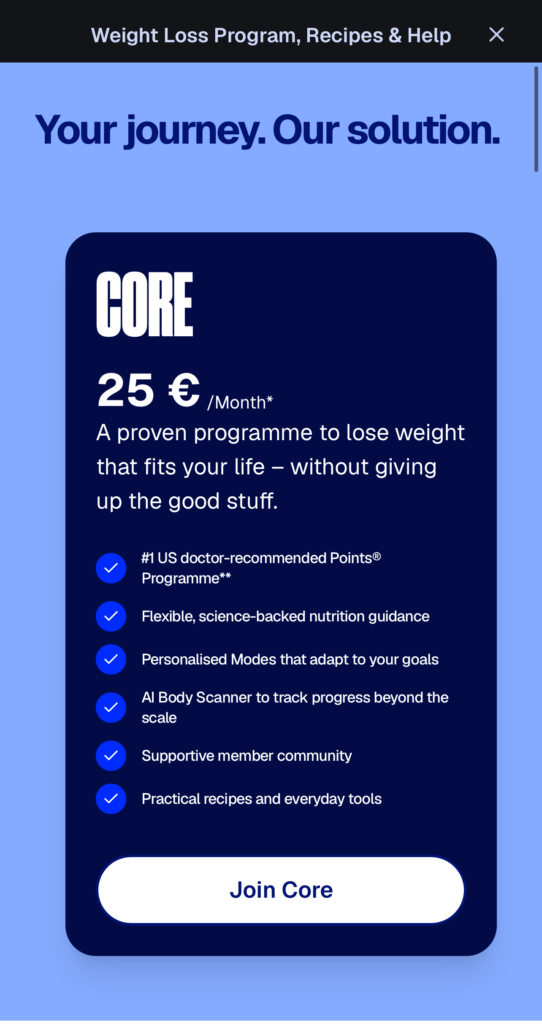
‘Price in Spain’
Does it work? What the evidence says, and what it doesn’t
WeightWatchers has more independent research behind it than almost any commercial program. That’s one of the strongest reasons to choose it.
The strongest evidence
- A large UK randomized trial in The Lancet (2011): adults referred to WeightWatchers by their doctors lost about twice as much weight over 12 months as those receiving standard care.
- A review in the Annals of Internal Medicine (2015): comparing commercial programs, it found WeightWatchers users lost at least 2.6% more weight at one year than people in control groups.
What to take with caution
- Company-reported results. WeightWatchers publishes member outcomes, such as average weight loss among members of menopausal age. These figures are useful but not independent, and they usually describe people who stayed engaged.
- Old studies, new app. The big trials tested earlier versions of the program. The core idea (structured eating, tracking and support) is the same, but the 2026 app and Modes haven’t been tested in the same way.
What this means for you
Expect steady, modest progress rather than dramatic results. On behavioral programs, most people lose a modest amount over a year, and results vary widely. The CDC notes that a gradual pace of about 1–2 pounds a week is more likely to last, and that losing just 5% of your body weight can improve blood pressure and blood sugar. The members who do best are usually the ones who keep tracking and use some form of support.
Is WeightWatchers stable after its 2025 bankruptcy?
It’s a fair question before paying for a year upfront. Here’s what happened and what it means for members.
- May–July 2025: WeightWatchers went through a Chapter 11 financial reorganization to cut its debt, and completed it in July 2025. During the process, the company said member programs, app access and workshops would continue as normal.
- December 2025: it relaunched with a redesigned app, new plan names (Core, Core+ and Med+) and Modes.
- September 2026: it named a new CEO, Stephen Bye.
- November 2026: it reported a profit for the third quarter of 2026, although revenue was about 11% lower than a year earlier. It also announced plans to use up to $10 million to pay down part of its remaining debt.
What this means for you: the program is running normally and the company is profitable again, but it’s still in the middle of a turnaround. For most people, that’s no reason to avoid it. If you’re cautious, an annual Core plan at around $120 limits what you have at stake, and you can check the in-person workshop schedule near you before choosing Core+.
Who should skip WeightWatchers, and what to use instead
WeightWatchers isn’t the right fit for everyone. If one of these sounds like you, a different option will probably serve you better.
“I mainly eat for emotional reasons.” WeightWatchers covers mindset, but mostly through coaching and workshops. Noom’s daily lessons focus directly on stress, cravings and habits. See our Noom review and Noom vs WeightWatchers.
“I want coaching, but Core+ is too expensive.” The Mayo Clinic Diet includes unlimited group coaching in a yearly price close to WeightWatchers Core. See WeightWatchers vs Mayo Clinic Diet.
“I just want to count calories for free.” Cronometer’s free plan includes barcode scanning and detailed nutrition data. See our best free weight loss apps.
“I hate tracking food every day.” A habit-based plan like the Mayo Clinic Diet, or simply building meals around vegetables and lean protein, may suit you better.
“I have a history of disordered eating.” Programs that score foods aren’t right for everyone. Talk to a doctor or registered dietitian before starting any tracking program.
Not sure where to start? Our guide on how to choose a weight loss program walks you through the decision step by step.
Before you sign up: a 6-point checklist
- I’ve decided between Core and Core+ using the break-even test above.
- I’m buying a plan of three months or longer, so there’s no starter fee.
- I’ve checked for an employer, health plan or warehouse club discount.
- I’ve looked for a first-month code to add at checkout.
- I’ve read the renewal line and set a reminder a week before it renews.
- I know where to cancel: the website, or the app store if I subscribe in the app.
Quick answers
How much does WeightWatchers cost per month in 2026? Core costs about $10–$12 a month on a 10- or 12-month plan, or about $24 a month plus a $20 starter fee month to month. Core+ costs about $20–$22 a month on a 12-month plan, or about $55 month to month.
Does WeightWatchers still use Points? Yes. The 2026 relaunch changed the app, plan names and added Modes, but Points and ZeroPoint foods work as before.
Can I get a refund if I cancel early? Refunds for unused months on commitment plans are uncommon. Cancellation usually takes effect at the end of the term.
Is WeightWatchers worth it? For most people, yes, on an annual Core plan bought during a sale. Core+ is worth it if you’ll use workshops or coaching at least twice a month.
How we reviewed WeightWatchers
We reviewed WeightWatchers’ plans pages and offer terms throughout 2026, company announcements and financial results, independent reviews and published research. Prices in this review were last checked in November 2026. [Your notes: add how long you used the program and which plan.] We update this page when prices or plans change.
Sources
- Weight Watchers: Plans and pricing
- Weight Watchers: Introducing the new Weight Watchers
- Weight Watchers: Here to stay (member information during the reorganization)
- Drizzle Me Skinny: What changed on Weight Watchers in 2026
- DealNews: Weight Watchers offers and terms (2026)
- Sam’s Club and Weight Watchers collaboration (July 2026)
- Benzinga: Weight Watchers Q3 2026 results and new CEO
- Weight Watchers announces discounted prepayment to reduce term loan debt (Nov 2026)
- Jebb et al., The Lancet (2011): Primary care referral to a commercial weight loss provider
- Gudzune et al., Annals of Internal Medicine (2015): Efficacy of commercial weight-loss programs
- CDC: Steps for losing weight
About the author
Written by Alex Morgan: I test health and weight loss apps by exploring their features, ease of use, pricing, tracking tools, personalization options, and overall user experience. I also compare user feedback and available evidence to assess how practical, reliable, and useful each app is for everyday life. My goal is to provide honest, straightforward reviews that help readers choose apps that fit their needs, preferences, and lifestyle.
Prices and terms are for general information and can change at any time. Always confirm the final price on the WeightWatchers website. This content does not replace professional medical or nutrition advice.